
Monthly Strategic Meetings
ESC Region 19
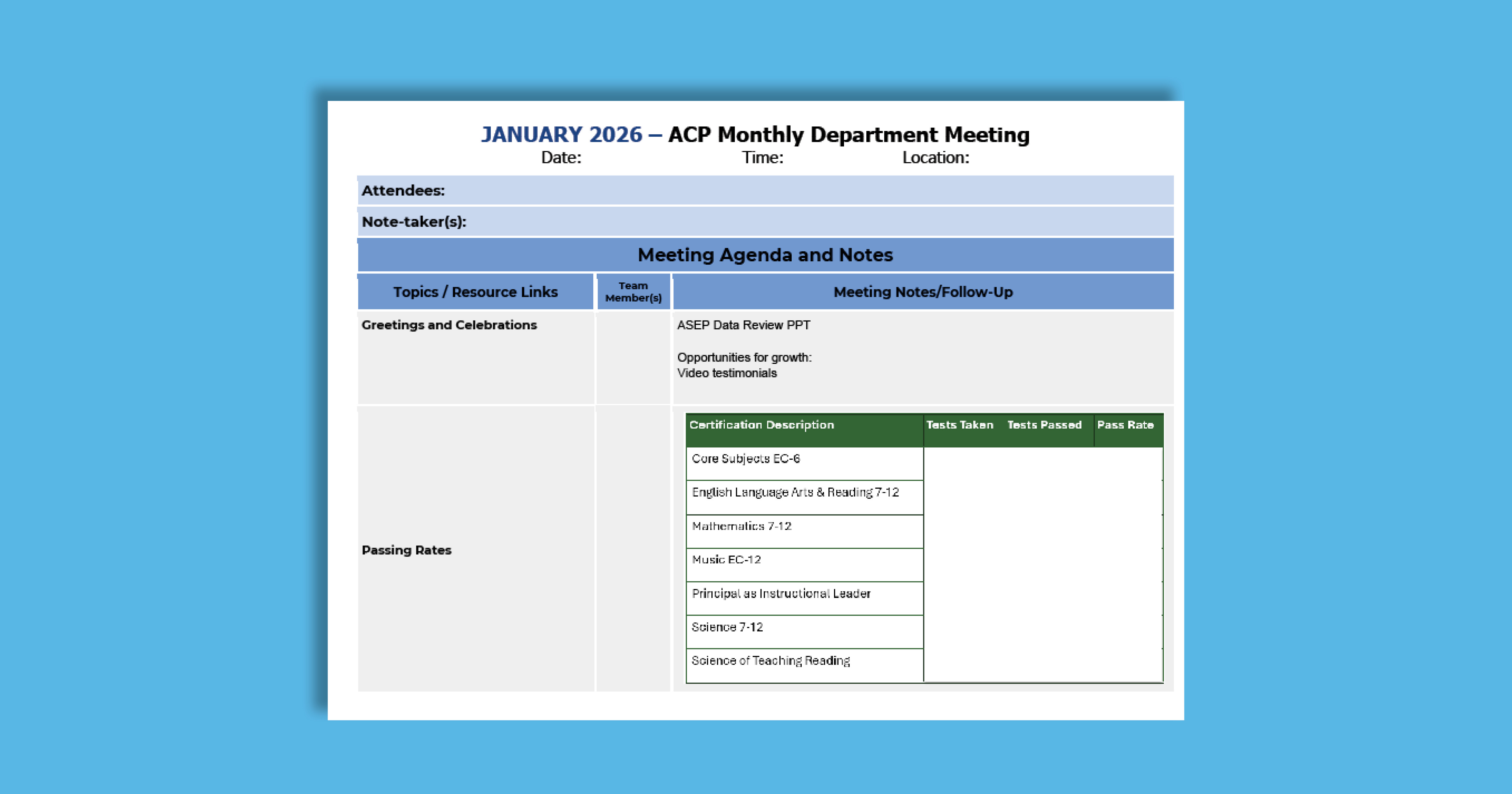
The purpose of this practice is to provide a structured, consistent agenda for monthly ACP department meetings. It was developed to address the need for greater coherence, data-informed discussions, and alignment across all certification pathways rather than informal or program-specific conversations. The template ensures that program data, accountability indicators, and shared priorities are reviewed consistently before transitioning into pathway-specific discussions. This structure strengthens transparency, collaboration, and continuous improvement across the department.
The targeted audience includes all Alternative Certification Program (ACP) staff, including program coordinators, facilitators, field supervisors, and leadership. This monthly meeting structure was implemented in 2020 and has since evolved into a protected, standing meeting focused on shared accountability, candidate progress monitoring, and program alignment. The meeting includes a department-wide session followed by program-specific discussions to ensure both coherence and pathway relevance.
Planning, Implementation, and Monitoring
This practice was initially designed by Teacher Preparation Program facilitators in response to increased access to certification and accountability data. When a facilitator assumed certification officer responsibilities, ASEP data and examination pass rates were intentionally integrated into meeting discussions. Adjustments to ASEP calculations and accountability expectations further refined the structure. The Assistant Director now incorporates ASEP indicators, exam performance, and recruitment data, while facilitators contribute agenda items to ensure shared ownership.
The primary goal during planning was to improve meeting efficiency, relevance, and data transparency across all certification pathways. A key focus was ensuring that all staff understood how the program is evaluated under ASEP measures and how individual program decisions impact outcomes. Success indicators included consistent review of accountability data, improved cross-program engagement, and measurable improvements in ASEP scores and examination pass rates. Increased awareness and ownership of program data were foundational goals.
The ACP department meets on the first Friday of each month from 9:00–11:00 a.m., with the agenda distributed one week in advance. The Director or Assistant Director facilitates the meeting, though all team members may submit agenda items and lead discussions. Meetings begin with department-wide topics, including data review and shared priorities, followed by program-specific sessions. Time allocations and agenda structures ensure consistency and focused execution.
Early implementation revealed that meetings were heavily teacher-program focused and extended beyond productive timeframes for other pathways. The structure was revised to establish clear time allocations, prioritize shared accountability data at the beginning of meetings, and separate program-specific discussions. This adjustment improved engagement, efficiency, and clarity of purpose across all programs.
This practice is monitored through regular review of ASEP indicators, examination pass rates, and state survey data (e.g., principal and teacher surveys). Examination performance data is reviewed monthly, while ASEP data is discussed consistently throughout the reporting cycle, with deeper analysis upon release of official reports. The Assistant Director collects and analyzes data and facilitates department-wide review and discussion. Findings are shared internally and with advisory stakeholders to inform decision-making.
Ongoing monitoring has contributed to improved examination pass rates and ASEP performance. The process has also highlighted opportunities to expand data collection, including candidate surveys, mentor feedback, and field supervisor input. Identified gaps in centralized survey systems have informed next steps toward developing a more cohesive data collection process. Continuous review allows the department to proactively adjust coursework, supports, and messaging.
A current challenge is the lack of a centralized survey system across all programs. Surveys are created independently and housed in different platforms, which limits consistency and data aggregation. Future scaling will require development of standardized instruments, centralized data storage, and defined timelines for survey administration. Establishing these structures would strengthen longitudinal data tracking and sustainability.
Impact on Teacher Preparation
This practice strengthens program coherence and alignment by ensuring consistent communication, shared data awareness, and coordinated candidate support. Regular review of accountability measures and candidate performance allows the department to identify areas where coursework or field supervision adjustments are needed. Structured discussions of candidate progress promote timely intervention and alignment with K–12 partner needs. Consistent messaging across staff improves candidate experience and program clarity.
Since implementation, examination pass rates and ASEP performance indicators have improved. Data-informed decision-making has led to targeted instructional adjustments and strengthened candidate preparation. District advisory feedback reflects satisfaction with candidate readiness and performance. The structured meeting process supports sustainability by embedding continuous improvement into routine departmental practice.